This Friendly Neighborhood Mary Jane #1 comic review looks at Marvel’s new solo series built around Mary Jane Watson.
Ashley Allen writes the series, while Phil Noto handles the interior artwork.
Mary Jane has spent years as a model, actress, friend, partner, hero, and survivor.
Now she is adding another job to the list.
Producer.
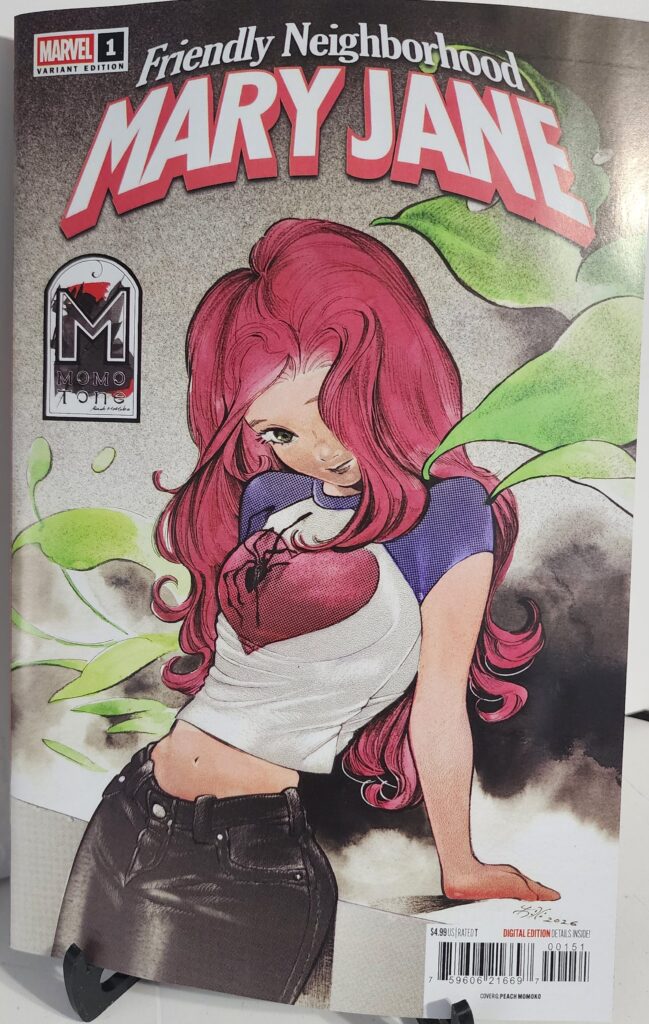
This copy features the Cover G Peach Momoko Momo-Tone Variant. Momoko gives Mary Jane a softer and more personal presentation, with flowing red hair, muted colors, and a quiet pose that separates this cover from the louder superhero variants surrounding the launch.
Comic Book Details
- Title: Friendly Neighborhood Mary Jane
- Issue: #1
- Volume: 1
- Publisher: Marvel Comics
- Release Date: November 4, 2026
- Cover Date: January 2027
- Written By: Ashley Allen
- Art: Phil Noto
- Cover Variant: Cover G Peach Momoko Momo-Tone Variant
- Cover Artist: Peach Momoko
- Cover Price: $4.99
- Pages: 32
- Rating: T
- UPC: 75960621669700151
Marvel introduces Mary Jane’s new role as producer at Watson Productions while Chameleon moves in to sabotage her plans.
Peach Momoko keeps the focus almost entirely on Mary Jane. Her flowing red hair and relaxed pose create a much quieter image than a typical superhero action cover.
The Momo-Tone style gives the image a softer texture, while the darker background keeps Mary Jane at the center of the composition.
Friendly Neighborhood Mary Jane #1 Comic Review: Story Analysis
Mary Jane Watson has always lived close to superheroes.
That does not mean her life has ever been simple.
She has dealt with danger, fame, relationships, villains, and the chaos that comes with being connected to Spider-Man’s world.
Friendly Neighborhood Mary Jane #1 gives her another chance to stand on her own.
This time, the story begins with Watson Productions.
Mary Jane is stepping into the role of producer.
That gives her something she can control.
At least, that is the plan.
Chameleon quickly threatens that stability.
His interest in sabotaging the production gives the first issue a direct conflict without reducing Mary Jane to someone waiting for Spider-Man to rescue her.
She has her own problem.
She has her own resources.
She also has something connected to Venom that may give her an unexpected advantage.
That creates a useful balance between Mary Jane’s civilian life and the superhero world surrounding her.
The series does not need to turn her into another traditional costumed hero.
Her strength comes from experience, intelligence, determination, and the strange situations she has already survived.
Art and Visual Design
Phil Noto handles the interior artwork.
That is a strong fit for Mary Jane.
Noto is especially good at faces, expressions, clothing, and quieter character moments.
Those elements matter in a book centered on someone whose life exists between celebrity culture and superhero chaos.
Mary Jane needs to feel like a real person rather than simply another figure standing beside Spider-Man.
Noto’s style helps accomplish that.
The production setting should also give the book room to explore environments outside the usual rooftops and battle scenes.
Studios, sets, offices, and public appearances can all become part of the visual identity.
That helps Friendly Neighborhood Mary Jane separate itself from a standard Spider-Man title.
The Peach Momoko Momo-Tone Cover
The Peach Momoko Momo-Tone Variant is the strongest reason to choose this particular edition.
Momoko does not surround Mary Jane with villains or explosions.
She lets the character carry the image.
Mary Jane stands in a simple pose while her red hair becomes the dominant visual element.
The shirt, dark jeans, pale background, and green leaves keep the palette restrained.
That restraint works.
Mary Jane does not need an action scene to be recognizable.
The red hair immediately identifies her.
Momoko then gives the image a softer emotional quality.
It feels more like a character portrait than a superhero poster.
That makes it especially appropriate for a series designed to give Mary Jane her own spotlight.
Mary Jane Watson
Mary Jane has existed in Spider-Man comics for decades, but her role has constantly changed.
She has been a model.
She has been an actress.
She has been Peter Parker’s partner and wife in different versions of Marvel continuity.
She has also developed an identity beyond those relationships.
Friendly Neighborhood Mary Jane builds directly on that idea.
Mary Jane is not simply reacting to Peter Parker’s life.
She is trying to build something herself.
Watson Productions gives her that opportunity.
The Chameleon threat immediately tests whether she can hold onto it.
That makes the conflict personal.
The villain is not just threatening New York.
He is threatening something Mary Jane created.
The Chameleon Threat
Chameleon is a particularly good villain for this kind of story.
His ability to change identities creates problems that do not require a massive battle.
A production company depends on people.
Actors.
Crew.
Executives.
Security.
Contacts.
Any one of those people could become a vulnerability when Chameleon is involved.
That gives the story room for paranoia and deception.
Mary Jane has spent enough time around superheroes to know that appearances can be dangerous.
The question is whether that experience will help her identify the threat before Chameleon destroys what she has built.
Collectibility and Market Significance
Friendly Neighborhood Mary Jane #1 launches a new Marvel series centered on one of Spider-Man’s most recognizable supporting characters.
Marvel released several covers for the first issue.
J. Scott Campbell created Cover A.
Russell Dauterman created Cover B.
Simone Di Meo supplied the 1:25 incentive.
Mr. Garcin created Cover D.
Bruce Timm created Cover E.
J. Scott Campbell also supplied the 1:100 virgin incentive.
Peach Momoko created the Cover G Momo-Tone Variant.
The Momoko edition is an open-order variant rather than a ratio incentive.
Collectors should not expect artificial scarcity.
Its appeal comes from the artist, the character, and the fact that this is issue #1.
Peach Momoko has a strong collector following.
Mary Jane also has a large audience beyond readers who collect every Spider-Man issue.
That gives this edition appeal to several groups at once.
Mary Jane collectors may want it.
Peach Momoko collectors may want it.
Spider-Man readers may want the launch issue.
Those factors make the Cover G variant one of the more visually distinctive regular covers for the book.
Final Verdict
Friendly Neighborhood Mary Jane #1 gives Mary Jane Watson a new direction without disconnecting her from the world readers already know.
Ashley Allen places her in charge of Watson Productions and immediately introduces a threat capable of attacking both her career and her personal life.
Phil Noto’s artwork gives the series a character-focused visual foundation.
The Peach Momoko Momo-Tone Variant adds a quieter and more elegant cover option.
Rather than treating Mary Jane as another superhero action figure, Momoko presents her as the center of the story.
That makes the cover fit the concept extremely well.
Recommended for Mary Jane Watson fans, Spider-Man readers, Peach Momoko collectors, Marvel collectors, and readers interested in seeing Mary Jane take the lead in her own series.
Friendly Neighborhood Mary Jane #1 Peach Momoko Momo-Tone Variant is available from Razmataz Comics & Hobbies at razmatazcomics.com while supplies last.