Magic: The Gathering Untold Stories Liliana #1 Comic Review – Abigail Larson Variant (2026)

Liliana Vess hunts Griselbrand on Innistrad in Magic: The Gathering Untold Stories Liliana #1, featuring an Abigail Larson variant cover.

This Magic: The Gathering Untold Stories Liliana #1 comic review looks at Dark Horse’s new four-part story about Liliana Vess.

Torunn Grønbekk writes the series. Nataliia Rerekina handles the interior artwork, with colors by Lauren Affe.

Liliana gained incredible power through bargains with four demons. Those bargains also cost her pieces of her freedom.

Now she wants them back.

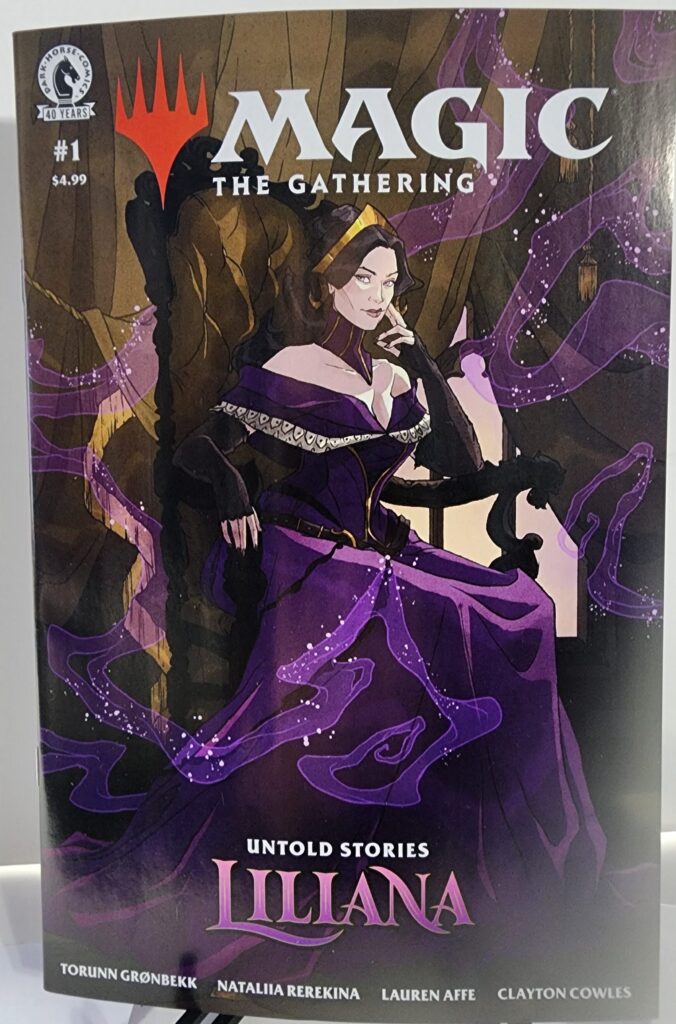
This copy features the Cover C Abigail Larson Variant. Larson presents Liliana surrounded by deep purple tones and flowing magical energy. The artwork immediately captures the dark fantasy style associated with the character.
Comic Book Details

  • Title: Magic: The Gathering: Untold Stories – Liliana
  • Issue: #1
  • Volume: 1
  • Publisher: Dark Horse Comics
  • Release Date: October 14, 2026
  • Cover Date: October 2026
  • Written By: Torunn Grønbekk
  • Art: Nataliia Rerekina
  • Colors: Lauren Affe
  • Letters: Clayton Cowles
  • Cover Variant: Cover C Abigail Larson Variant
  • Cover Artist: Abigail Larson
  • Cover Price: $4.99
  • Pages: 32
  • Rating: T
  • UPC: 76156801633800131
  • Series Length: 4 issues

Dark Horse confirms the creative team, $4.99 price, 32-page length, and four-issue format. PRH Comics

Abigail Larson’s cover leans directly into Liliana’s dark fantasy identity. Purple dominates the image, while spectral energy moves around her throne.

Liliana looks completely in control, but the darker background hints at the dangerous bargains that continue to shape her life.

Magic: The Gathering Untold Stories Liliana #1 Comic Review: Story Analysis

Liliana Vess possesses enormous power.

That power came with a price.

She bargained her soul to four powerful demons: Kothophed, Razaketh, Belzenlok, and Griselbrand.

Liliana eventually decided that freedom mattered more than the power those bargains gave her. She began hunting the demons tied to her contracts.

This story follows that struggle.

Her search brings her to Innistrad, where she believes she can find Griselbrand. The plane already suffers from corruption, chaos, and violence.

Liliana therefore walks into danger before she even reaches her true target.

The story also gives Dark Horse a chance to explore part of Liliana’s history rather than simply retell events Magic players already know. The publisher specifically presents this as an untold story from her past. PRH Comics

That makes the book accessible in two ways.

Longtime Magic players get another piece of Liliana’s history.

Newer readers get a straightforward dark fantasy story about a necromancer trying to escape the consequences of her own choices.

Art and Visual Design

Nataliia Rerekina handles the interior artwork.

Liliana’s story needs a strong sense of atmosphere. Innistrad is not a bright heroic fantasy setting.

It is a place filled with corruption, monsters, death, and supernatural danger.

That environment suits Liliana.

She works with death rather than running from it. Her magic can make horrific places feel almost natural to her.

The artwork therefore has to balance two ideas. Innistrad must feel threatening, but Liliana must still appear capable of surviving there.

For this edition, Abigail Larson’s cover pushes the gothic atmosphere even further.

Liliana sits almost like dark royalty. Purple magical shapes move throughout the composition.

The image is elegant rather than chaotic.

That suits Liliana because her danger often comes from confidence and control rather than brute force.

Liliana Vess

Liliana remains one of Magic: The Gathering’s most recognizable Planeswalkers.

Her power has always come with consequences.

The demonic bargains at the center of this story are a perfect example.

Liliana wanted greater power. She got it.

She also discovered that power does not mean much when someone else owns part of your future.

That gives the story a strong personal motivation.

Liliana does not hunt Griselbrand because someone ordered her to do it. She wants control over her own life.

That motivation makes her easy to understand even for readers who do not know every part of Magic lore.

She made terrible deals.

Now she intends to break them.

Innistrad and the Horror Setting

Innistrad is an excellent setting for this story.

The plane already mixes fantasy with gothic horror.

Vampires, demons, undead creatures, and other supernatural threats are normal parts of its world.

Liliana fits comfortably inside that environment.

Her necromancy does not feel out of place there. In many situations, she may be one of the least frightening things around.

That gives the series room to embrace horror without changing who Liliana is.

It also creates a good contrast.

Liliana arrives looking for one specific demon, but Innistrad contains plenty of other threats that can interfere with her plans.

Collectibility and Market Significance

Magic: The Gathering: Untold Stories – Liliana #1 begins a new four-issue Dark Horse miniseries.

Dark Horse released three regular covers for the first issue.

Nataliia Rerekina created Cover A. Sibylline Meynet created Cover B. Abigail Larson created Cover C. comicsbodega.com

All three carry the same original $4.99 cover price.

That means the Abigail Larson edition is an open-order variant rather than a ratio incentive.

Collectors should not assume scarcity based only on the variant designation.

The appeal comes from several other factors.

It is issue #1. It stars Liliana Vess. It begins a short four-part story. It also features artwork from a named cover artist with a style that fits the character particularly well.

Magic: The Gathering also brings a collector audience beyond traditional comic readers.

That makes the series interesting for both comic collectors and Magic fans who normally focus on cards or game-related merchandise.

Final Verdict

Magic: The Gathering: Untold Stories – Liliana #1 starts with a strong character and a simple goal.

Liliana wants her freedom.

Getting it means confronting the demons who hold pieces of her soul.

Torunn Grønbekk uses that premise to explore Liliana’s past while sending her into the gothic horror world of Innistrad.

Nataliia Rerekina supplies the interior artwork, while Abigail Larson gives this edition a strong dark-fantasy cover.

The Abigail Larson Cover C Variant is especially attractive for collectors who already associate Liliana with purple magic, necromancy, and gothic imagery.

Recommended for Magic: The Gathering fans, Liliana Vess collectors, Abigail Larson collectors, dark fantasy readers, and anyone interested in exploring Magic lore through comics.


Magic: The Gathering: Untold Stories – Liliana #1 Abigail Larson Variant is available from Razmataz Comics & Hobbies at razmatazcomics.com while supplies last.
The Amazing Spider-Man #1001 Comic Review – Mark Bagley Variant (2026)

Spider-Man battles Ravage after issue #1000 in Amazing Spider-Man #1001. We look at Joe Kelly’s story and the Mark Bagley variant cover.

This Amazing Spider-Man #1001 comic review looks at the first chapter following Marvel’s landmark 1000th issue of Amazing Spider-Man. Writer Joe Kelly and artist Pepe Larraz immediately move Peter Parker into the aftermath of that milestone as Spider-Man faces Ravage and discovers that Aunt May is caught directly in the middle of the conflict.

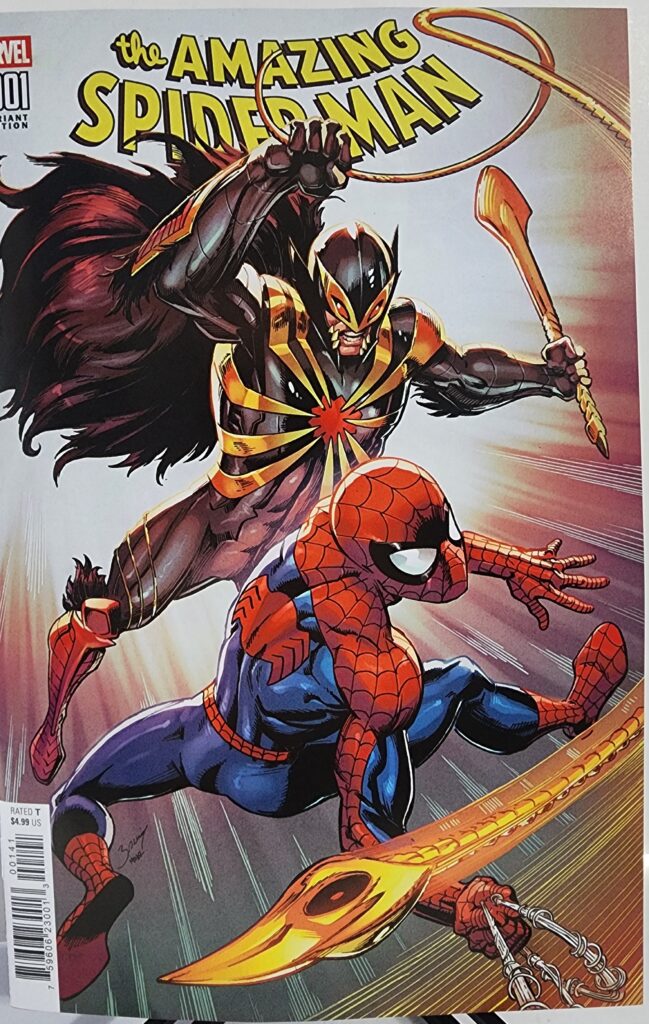
This copy features the Cover C Mark Bagley Variant, bringing one of the most recognizable modern Spider-Man artists back to the character for a dynamic battle cover.

Comic Book Details

  • Title: The Amazing Spider-Man
  • Issue: #1001
  • Volume: 7
  • Publisher: Marvel Comics
  • Release Date: October 14, 2026
  • Cover Date: December 2026
  • Written By: Joe Kelly
  • Art: Pepe Larraz
  • Cover Variant: Cover C Mark Bagley Variant
  • Cover Artist: Mark Bagley
  • Cover Price: $4.99
  • Rating: T
  • UPC: 75960623001300141

Mark Bagley’s variant throws Spider-Man directly into combat with Ravage, using the kind of fluid movement and exaggerated action that has defined much of Bagley’s Spider-Man work.

Spider-Man twists through the foreground while Ravage attacks from above with multiple weapons, creating a fast-moving composition that immediately establishes the physical threat facing Peter after the events of issue #1000.

The Amazing Spider-Man #1001 Comic Review: Story Analysis

The Amazing Spider-Man #1001 has the difficult job of following one of the biggest numerical milestones in Marvel history.

Rather than treating the issue as a quiet reset after #1000, writer Joe Kelly immediately pushes Peter Parker into another crisis.

Spider-Man is forced to battle Ravage, the frightening new enemy introduced around the milestone issue, but the conflict becomes considerably more personal when Aunt May is placed in danger.

That creates stakes beyond whether Spider-Man can simply defeat another villain.

Peter’s relationship with Aunt May has always been one of the emotional foundations of Amazing Spider-Man. Any threat to her immediately changes the nature of the fight, especially when Peter is already dealing with the consequences of what happened in issue #1000.

The result is an issue designed to show that reaching #1000 was not an ending. It was the beginning of the next problem.

Art and Visual Design

Pepe Larraz handles the interior artwork, continuing Marvel’s emphasis on large-scale, energetic superhero action.

Spider-Man benefits enormously from an artist who can communicate speed and movement. His fights are rarely simple exchanges of punches; Peter swings, twists, dodges, falls, and improvises while constantly changing position.

A villain like Ravage gives Larraz an opportunity to contrast Spider-Man’s agility with a much more physically intimidating opponent.

For this particular copy, however, Mark Bagley’s variant cover is the major visual attraction.

Bagley has one of the longest and most recognizable histories with Spider-Man of any modern artist. His work on Amazing Spider-Man and Ultimate Spider-Man helped define Peter Parker for generations of readers.

That history makes a Bagley cover on the issue immediately following #1000 especially appropriate.

Character Development

Peter Parker begins issue #1001 dealing with more than another costumed enemy.

The danger surrounding Aunt May brings Peter back to one of his oldest fears: that the people closest to him will suffer because he is Spider-Man.

That fear has shaped Peter since the beginning of his career.

No matter how experienced Spider-Man becomes or how powerful the opponent, Peter never completely escapes the responsibility he feels toward his family and friends.

Ravage therefore represents more than a physical threat. If Aunt May is caught in the middle, Peter is forced to confront the possibility that his life as Spider-Man has once again placed someone he loves in danger.

That personal connection helps prevent the aftermath of issue #1000 from becoming simply another oversized superhero battle.

Collectibility and Market Significance

The Amazing Spider-Man #1001 is naturally tied to one of the biggest milestones in the title’s history.

Issue #1000 attracted an enormous creative lineup and celebrated more than six decades of Spider-Man stories. Issue #1001 is where the regular narrative has to continue after that celebration. Midtown Comics

The Mark Bagley Variant adds another collectible angle.

Bagley is strongly associated with Spider-Man and remains particularly popular with readers who followed either his Amazing Spider-Man work or his record-setting Ultimate Spider-Man run.

This is an open-order variant rather than a limited incentive cover, so scarcity should not automatically be assumed.

Its appeal instead comes from the combination of a historically significant issue number, a new Spider-Man villain, and artwork from an artist with a major connection to the character.

For collectors who prefer artist-focused variants, the Bagley cover is an especially natural choice for an Amazing Spider-Man issue.

Final Verdict

The Amazing Spider-Man #1001 proves that Marvel did not intend issue #1000 to function as a stopping point.

Joe Kelly immediately continues the conflict with Ravage while making the situation more personal by placing Aunt May in danger.

Pepe Larraz provides the interior action, while Mark Bagley’s variant gives longtime Spider-Man readers a cover from one of the artists most closely associated with Peter Parker’s modern history.

For collectors, the Mark Bagley Variant offers a strong combination of character history and milestone significance without requiring the premium attached to a ratio incentive edition.

Recommended for Amazing Spider-Man readers, Peter Parker fans, Mark Bagley collectors, and anyone continuing directly from the landmark issue #1000.


The Amazing Spider-Man #1001 Mark Bagley Variant is available from Razmataz Comics & Hobbies at razmatazcomics.com while supplies last.
Teenage Mutant Ninja Turtles #23 Comic Review – Damien Worm IDW Goes Dark Variant (2026)

The undead invade New York in TMNT #23. We look at The City That Never Dies storyline and Damien Worm’s IDW Goes Dark variant.

This Teenage Mutant Ninja Turtles #23 comic review looks at the latest chapter of IDW’s The City That Never Dies storyline from writer Gene Luen Yang and artist Fero Pe. New York’s supernatural crisis reaches a new level as the barrier between the living and the dead begins to collapse and the Turtles are forced to fight on multiple fronts.

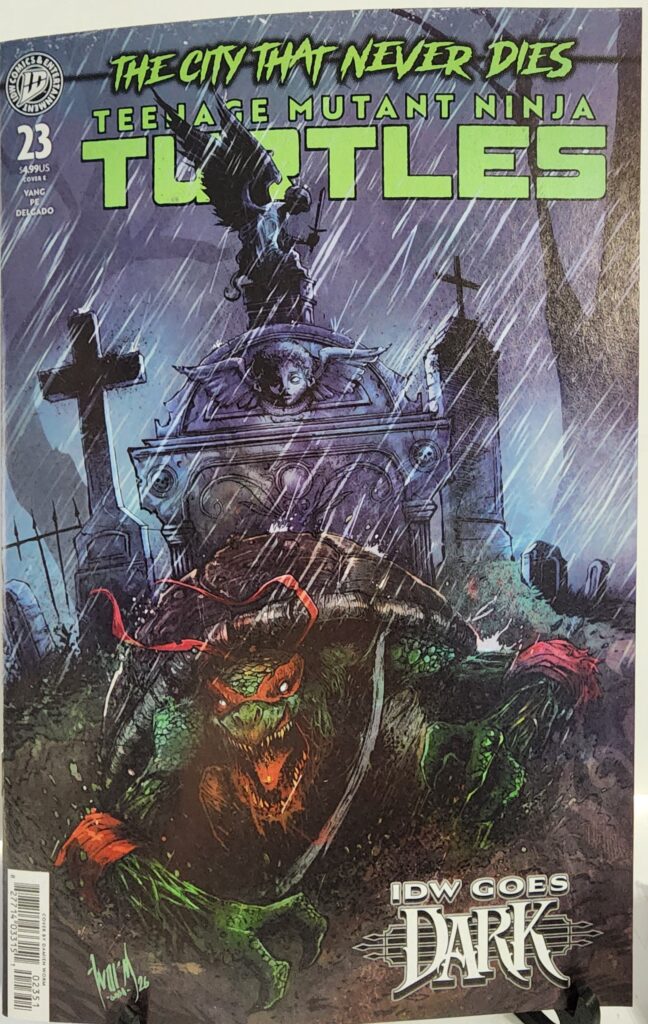
This copy features the Cover E Damien Worm IDW Goes Dark Variant, transforming Raphael and the TMNT world into a much darker horror-inspired image.

Comic Book Details

Title: Teenage Mutant Ninja Turtles
Issue: #23
Volume: 1
Publisher: IDW Publishing
Release Date: October 14, 2026
Cover Date: October 2026
Written By: Gene Luen Yang
Art: Fero Pe
Colors: Luis Antonio Delgado
Cover Variant: Cover E IDW Goes Dark Variant
Cover Artist: Damien Worm
Cover Price: $4.99
Pages: 32
UPC: 82771403315102351
Storyline: The City That Never Dies, Part Three

Damien Worm’s cover pushes Teenage Mutant Ninja Turtles directly into horror territory. Raphael charges through a rain-soaked cemetery while distorted figures and ominous architecture surround him.

The dark greens, purples and heavy shadows fit the IDW Goes Dark theme perfectly, giving the familiar TMNT world the atmosphere of a supernatural horror comic rather than a traditional martial-arts adventure.

Teenage Mutant Ninja Turtles #23 Comic Review: Story Analysis

Teenage Mutant Ninja Turtles #23 continues The City That Never Dies as the supernatural invasion of New York grows increasingly dangerous.

The veil between worlds has collapsed, allowing undead members of the Foot Clan, Purple Dragons and other threats to spill into the city. With the crisis spreading too quickly for the Turtles to handle as a single group, they are forced to divide their efforts.

At the same time, Baxter Stockman forms a dangerous new alliance while Shinigami faces questions about where her loyalty truly lies.

That setup gives writer Gene Luen Yang several conflicts to develop at once. The Turtles are not simply confronting another gang or mutant enemy—the city itself is becoming increasingly hostile as the distinction between the living and the dead begins to disappear. Penguin Random House Comics Retail

The supernatural direction also fits TMNT surprisingly well. The franchise has always mixed martial arts, science fiction, mutants and mysticism, so an undead invasion does not feel out of place.

Art and Visual Design

Fero Pe handles the interior artwork, with Luis Antonio Delgado providing colors. Grand Comics Database

A story involving an undead New York gives the creative team an opportunity to make familiar streets and characters feel less safe than usual.

Rain, darkness, supernatural enemies and the breakdown of normal city life all push the visual tone toward horror while still allowing the Turtles’ action-heavy style to remain at the center of the book.

For this edition, however, Damien Worm’s cover is the immediate attraction.

Worm’s work naturally suits horror imagery, and the IDW Goes Dark theme gives him room to emphasize atmosphere instead of presenting the Turtles in a conventional action pose.

The result looks almost like a horror paperback illustration, with Raphael appearing less like a superhero and more like a lone survivor moving through a nightmare.

Character Development

Splitting the Turtles apart creates opportunities to emphasize their individual personalities instead of relying entirely on the group dynamic.

The larger supernatural conflict also tests characters outside the four brothers.

Shinigami’s loyalty becomes increasingly important as alliances shift, while Baxter Stockman’s new partnership threatens to make an already chaotic situation worse.

That gives the issue multiple personal conflicts beneath the larger undead invasion.

The Turtles have survived countless threats together, but a crisis that forces them to operate separately changes the equation. Each brother has to deal with danger without immediately relying on the rest of the family.

Collectibility and Market Significance

Teenage Mutant Ninja Turtles #23 has several things that make this particular edition appealing to collectors.

The issue is part of The City That Never Dies storyline, released during IDW’s October horror promotion, and features one of the company’s IDW Goes Dark variant covers.

The Damien Worm Cover E is an open-order variant rather than a ratio incentive, so it should not automatically be treated as scarce. IDW also released other covers for the issue, including variants by Kevin Eastman and Ben Bishop, Marcelo Ventura, J. Gonzo and incentive editions. Penguin Random House Comics Retail

Its appeal comes primarily from the artwork and the IDW Goes Dark theme.

For collectors who like darker TMNT imagery, horror comics or Damien Worm’s work, this version has a distinct visual identity that separates it from the regular covers.

Final Verdict

Teenage Mutant Ninja Turtles #23 pushes The City That Never Dies deeper into supernatural horror while keeping the core TMNT combination of action, family and strange New York threats intact.

Gene Luen Yang’s storyline expands the conflict by forcing the Turtles to split up while Baxter Stockman and Shinigami add additional complications.

For collectors, the Damien Worm IDW Goes Dark Variant is especially well matched to the story. Its cemetery setting, rain-soaked atmosphere and horror styling make it one of the more distinctive covers for the issue.

Recommended for TMNT readers, Damien Worm collectors, horror-comic fans and anyone following The City That Never Dies storyline.


Teenage Mutant Ninja Turtles #23 Damien Worm IDW Goes Dark Variant is available from Razmataz Comics & Hobbies at razmatazcomics.com while supplies last.

Infernal Hulk vs. Fantastic Four #1 Comic Review: Story Analysis

Infernal Hulk attacks the Fantastic Four in this Hulk War prelude. We look at the story, Cian Tormey’s art and Clayton Crain variant.

Infernal Hulk vs. Fantastic Four #1 begins with New York under threat and Reed Richards holding what may be one of the few weapons capable of stopping the coming disaster.

That weapon is the Immaculate Engine, a mysterious supernatural machine housed inside the Baxter Building.

Infernal Hulk knows exactly what it represents.

If Reed can activate the engine, Hulk’s growing army could potentially be destroyed in a single strike. That makes the Fantastic Four and their headquarters an obvious target.

Writer Phillip Kennedy Johnson uses the setup to bring two very different corners of Marvel together. The Fantastic Four traditionally approach impossible problems through science, exploration and teamwork. Infernal Hulk represents something far more primal and supernatural.

That collision creates the central tension of the issue.

The Fantastic Four are not simply trying to overpower Hulk. They have to resist his corruptive influence long enough to protect Reed’s invention and prevent themselves from being transformed into new recruits for the Infernal Avengers.

As a Hulk War Prelude, the one-shot also functions as a bridge into the larger conflict rather than an isolated battle.

Art and Visual Design

Cian Tormey handles the interior artwork, and the premise gives him a wide range of visual material to work with.

The Fantastic Four bring bright superhero imagery, technology and the familiar environments of the Baxter Building. Infernal Hulk brings monstrous proportions, supernatural corruption and horror.

That contrast is important because the story depends on Hulk feeling fundamentally different from the kind of threats Reed Richards usually solves with another invention.

The result is a battle between clean Marvel science-fiction imagery and something darker and less predictable.

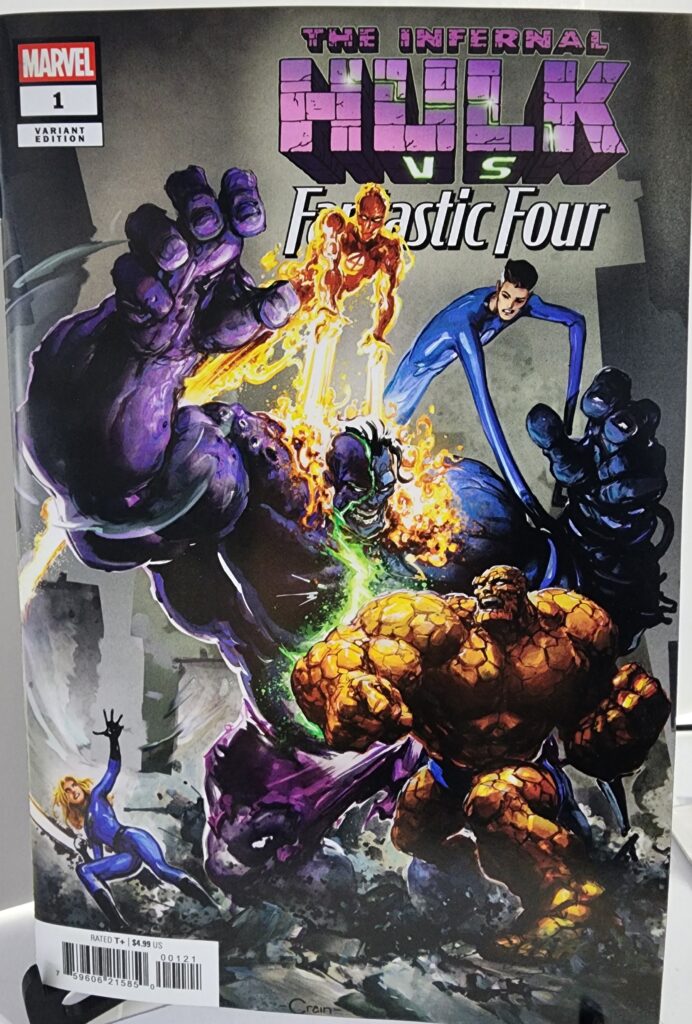
For this edition, Clayton Crain’s variant cover pushes heavily into that horror side.

Crain’s Infernal Hulk feels enormous, distorted and almost demonic, while the Fantastic Four appear comparatively small beneath him. The composition reinforces the scale of the threat before the reader ever opens the book.

Character Development

Reed Richards sits at the center of the conflict because the Immaculate Engine represents exactly the sort of solution readers expect from Mister Fantastic.

When an impossible threat appears, Reed builds something capable of confronting it.

The problem this time is that building the solution also makes the Fantastic Four a target.

Infernal Hulk understands that destroying the machine may not be enough. Corrupting the people responsible for it could turn some of Marvel’s greatest heroes into weapons against everyone else.

That gives the battle a more personal dimension than a simple Hulk-versus-Thing rematch.

The Fantastic Four have always been strongest as a family. A supernatural threat capable of twisting members of that family against one another attacks the team at its most important foundation.

Collectibility and Market Significance

Infernal Hulk vs. Fantastic Four #1 has several features that make it interesting for collectors.

It is a one-shot, serves as a Hulk War Prelude, and puts the Fantastic Four directly into the growing Infernal Hulk storyline.

Marvel released the issue with several covers, including regular open-order variants from Clayton Crain, Danny Earls and Ken Lashley, along with higher-ratio incentive covers by Greg Land and Ken Lashley. Penguin Random House Comics Retail

The Clayton Crain Variant is an open-order cover rather than a ratio incentive, so scarcity should not automatically be assumed.

Its appeal comes instead from Crain’s artwork and the subject matter.

Crain’s painted approach is especially well suited to Hulk, symbiotes and darker supernatural characters, making his version visually distinct from the other standard covers for the issue.

The combination of Fantastic Four, Infernal Hulk, a crossover one-shot and a named modern cover artist gives the book several different collector audiences.

Final Verdict

Infernal Hulk vs. Fantastic Four #1 takes the Fantastic Four out of their usual science-fiction comfort zone and throws them directly into the supernatural horror surrounding Infernal Hulk.

Phillip Kennedy Johnson’s premise gives Reed Richards something potentially capable of ending Hulk’s army while simultaneously making the entire Fantastic Four a target.

Cian Tormey handles the interior conflict, while Clayton Crain’s variant cover emphasizes the monstrous scale of Infernal Hulk and the danger facing Marvel’s First Family.

For collectors, the Clayton Crain Variant is one of the stronger visually themed versions of the issue, particularly for readers who prefer the darker side of modern Hulk stories.

Recommended for Hulk readers, Fantastic Four fans, Clayton Crain collectors, and anyone following the buildup to Hulk War.


Infernal Hulk vs. Fantastic Four #1 Clayton Crain Variant is available from Razmataz Comics & Hobbies at razmatazcomics.com while supplies last.
Wolverine: Paradise #1 Comic Review – Phil Noto Foil Variant (2026)

Logan heads to Miami in Wolverine: Paradise #1. We look at Dan Panosian’s new series, Dazzler’s role and the Phil Noto foil variant.

This Wolverine: Paradise #1 comic review looks at Marvel’s new 2026 Wolverine series from writer and artist Dan Panosian. Logan steps away from the X-Men and heads to Miami, where the city’s glitz and glamour hide a dangerous criminal underworld waiting to drag Wolverine back into trouble.

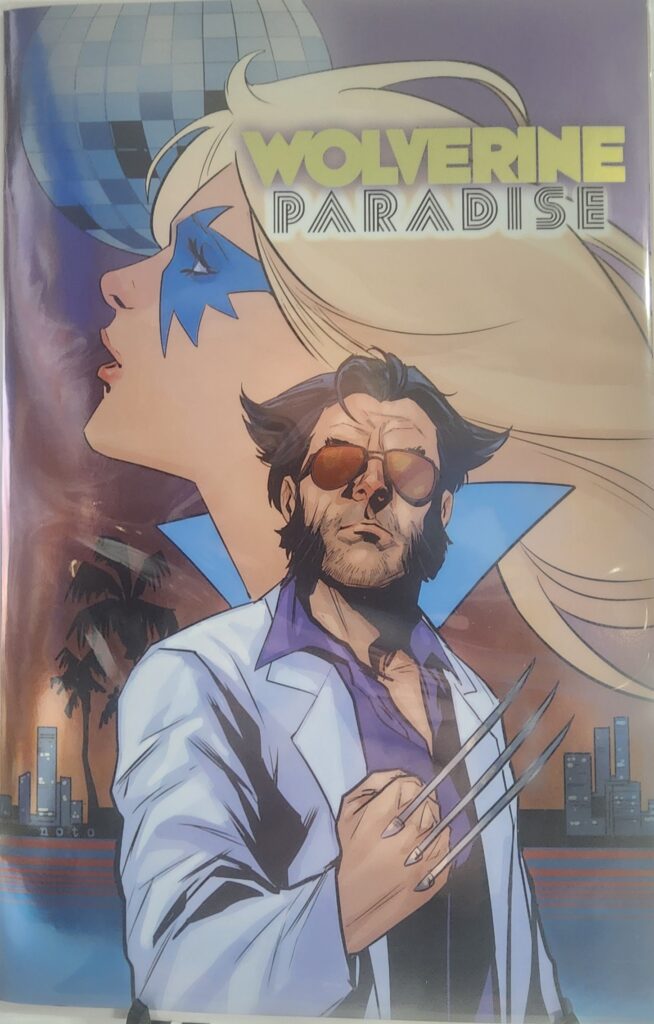
This copy features the Phil Noto Cover D Foil Variant, with Logan dressed for Miami nightlife while Dazzler dominates the background in a stylish retro composition.

Comic Book Details

  • Title: Wolverine: Paradise
  • Issue: #1
  • Volume: 1
  • Publisher: Marvel Comics
  • Release Date: October 14, 2026
  • Written By: Dan Panosian
  • Art: Dan Panosian
  • Cover Variant: Cover D Phil Noto Foil Variant
  • Cover Artist: Phil Noto
  • Cover Price: $7.99
  • Rating: T+
  • UPC: 75960621351100121

Phil Noto’s foil cover gives Wolverine a completely different look from the usual battlefield or wilderness imagery associated with the character. Logan stands in a white jacket and sunglasses with his claws extended, while Dazzler and a disco-inspired background reinforce the Miami setting.

The foil treatment fits the nightlife theme particularly well, giving the cover a polished, almost poster-like appearance that stands apart from the more traditional Wolverine variants.

Wolverine: Paradise #1 Comic Review: Story Analysis

Wolverine: Paradise #1 takes Logan somewhere considerably different from his usual surroundings.

After stepping away from the X-Men, Wolverine heads to Miami looking for a change of pace. What he finds instead is a city where glamour, nightlife, and wealth sit directly above a dangerous criminal underworld.

That setup gives writer and artist Dan Panosian an opportunity to pull Wolverine out of familiar territory. Rather than placing Logan in another wilderness survival story or mutant conflict, the series drops him into a stylish urban environment where the danger is hidden beneath the surface.

The premise works because Logan is never particularly good at staying out of trouble. Even when he attempts to distance himself from the X-Men and the larger superhero world, violence has a way of finding him.

The addition of Dazzler also makes sense for the Miami setting. Her celebrity background and connection to music and nightlife give the story a character who naturally fits the environment while providing a strong contrast to Logan’s rougher personality.

Art and Visual Design

Because Dan Panosian handles both the writing and artwork, Wolverine: Paradise has a strong unified visual identity.

Miami gives Panosian an opportunity to work with a very different palette and atmosphere than readers might normally associate with Wolverine. Bright lights, nightlife, tropical scenery, and upscale environments create a sharp contrast with Logan himself.

That contrast helps sell the central idea of the book: Wolverine may have traveled to paradise, but he does not necessarily belong there.

For this particular version, Phil Noto’s foil variant leans heavily into the stylish side of the concept. Logan’s white jacket, sunglasses, and exposed claws give him a sleek Miami look while still making it immediately clear that Wolverine is never far from violence.

Dazzler’s oversized portrait in the background ties the cover directly to the issue’s setting and supporting cast, while the foil finish adds another layer to the disco-inspired presentation.

Character Development

Wolverine: Paradise #1 begins with Logan attempting to separate himself from the X-Men and find something resembling a break from his usual life.

That idea alone gives the story room to explore Wolverine outside of the team dynamic.

Logan has always struggled with the idea of peace. Even when he wants a quieter life, his instincts, reputation, and history tend to pull him back toward violence.

Placing him in Miami creates an interesting contradiction. The setting promises sunshine, glamour, and escape, while Logan remains someone constantly prepared for the next fight.

Dazzler offers another contrast. She is comfortable in the world of entertainment and nightlife, while Wolverine approaches that environment as an outsider. Their different personalities give the series an opportunity to explore Logan from a different angle than the usual mutant-team setting.

Collectibility and Market Significance

Wolverine: Paradise #1 has several things working in its favor as a collectible.

It is the first issue of a new Wolverine series, features Dan Panosian as both writer and artist, introduces a new Miami-based direction for Logan, and includes Dazzler as a prominent supporting character.

Marvel released the issue with several different covers, including standard variants and higher-ratio incentives. The Phil Noto Cover D Foil Variant carries a higher original cover price of $7.99, compared with $4.99 for the standard covers. Midtown Comics

This is not a ratio incentive variant, so scarcity should not automatically be assumed. Its appeal comes primarily from Phil Noto’s artwork, the foil treatment, Wolverine, and Dazzler.

That combination gives it strong display appeal for collectors who follow Wolverine, Dazzler, Phil Noto, or modern Marvel foil variants.

Final Verdict

Wolverine: Paradise #1 gives Logan a refreshing change of scenery without abandoning the qualities that make Wolverine work.

Dan Panosian’s Miami setting provides a strong contrast to Logan’s personality, while the criminal-underworld premise ensures that the idea of “paradise” probably will not last very long.

The inclusion of Dazzler gives the series another character who naturally fits the setting and helps distinguish it from a standard Wolverine solo story.

For collectors, the Phil Noto Foil Variant is one of the more visually distinctive versions of the issue. Its retro Miami styling, Wolverine-and-Dazzler composition, and foil finish make it especially attractive as a display copy.

Recommended for Wolverine fans, Dazzler collectors, Phil Noto collectors, and readers looking for a different kind of Wolverine story.


Wolverine: Paradise #1 Phil Noto Foil Variant is available from Razmataz Comics & Hobbies at razmatazcomics.com while supplies last.