Starship Godzilla: Invasion X #1 Comic Review – Joëlle Jones Variant (2026)

Godzilla returns to space in Starship Godzilla: Invasion X #1, beginning a five-issue sequel featuring a Joëlle Jones Cover B variant.

This Starship Godzilla Invasion X #1 comic review looks at the beginning of IDW’s five-part follow-up to the original Starship Godzilla series.

Chris Gooch returns as writer. Oliver Ono handles the interior artwork, with colors by Valentina Pinto and lettering by Hassan Otsmane-Elhaou.

The crew survived its first battle with the Xiliens.

Unfortunately, winning the battle helped start a war.

Now Starship Godzilla needs upgrades, hostile aliens are closing in, and the Xiliens are preparing something even more dangerous.

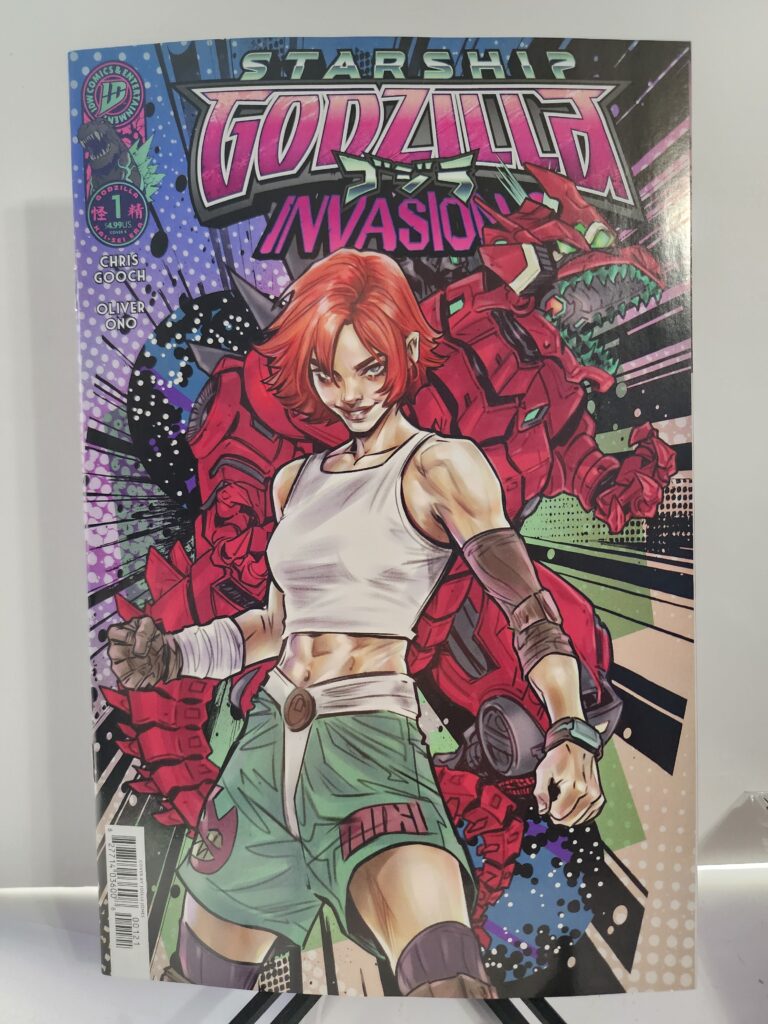
This copy features the Cover B Joëlle Jones Variant. Jones places a determined human character in the foreground while a massive red armored Godzilla dominates the background. Bright reds, greens, purples, and heavy graphic shapes give the cover an energetic science-fiction feel.
Comic Book Details

  • Title: Starship Godzilla: Invasion X [Kai-Sei Era]
  • Issue: #1
  • Volume: 1
  • Publisher: IDW Publishing
  • Release Date: October 14, 2026
  • Cover Date: October 2026
  • Written By: Chris Gooch
  • Art: Oliver Ono
  • Colors: Valentina Pinto
  • Letters: Hassan Otsmane-Elhaou
  • Cover Variant: Cover B Joëlle Jones Variant
  • Cover Artist: Joëlle Jones
  • Cover Price: $4.99
  • Pages: 36
  • Rating: T+
  • UPC: 82771403600800121
  • Series Length: 5 issues

IDW lists Starship Godzilla: Invasion X as a five-issue follow-up to the first Starship Godzilla series. Penguin Random House Comics Retail

Joëlle Jones gives Cover B a very different personality from a traditional Godzilla destruction scene. The human figure commands the foreground while the enormous armored Godzilla rises behind her.

The bright red mechanical design immediately sells the idea that this is not simply another monster attack story. This is Godzilla pushed directly into colorful space-opera territory.

Starship Godzilla Invasion X #1 Comic Review: Story Analysis

The original Starship Godzilla story ended with a victory.

Invasion X #1 begins by showing the cost of that victory.

The crew defeated the Xiliens in battle, but they did not eliminate the threat.

Instead, their actions escalated the conflict.

The crew now needs to improve Starship Godzilla before the next confrontation arrives.

They do not have much time.

M Space Hunter Nebula Aliens are already pursuing them for a bounty.

At the same time, the Xiliens are working on the final pieces of a new cosmic kaiju weapon.

Chris Gooch therefore begins the sequel with pressure coming from several directions.

The heroes have problems with their ship.

Enemies are hunting them.

A larger weapon is being built somewhere else.

That gives the first issue a useful sense of momentum.

This is not a new crew slowly discovering the universe.

These characters have already fought a war.

Now they must deal with what happened because they won.

Art and Visual Design

Oliver Ono returns for the interior artwork.

Starship Godzilla requires a strange combination of visual styles.

It needs giant-monster action.

It also needs spaceships, alien technology, strange worlds, and the scale of a science-fiction adventure.

Those elements could easily fight each other.

Instead, the concept works because the book embraces the excess.

Godzilla already feels enormous on Earth.

Putting the character into a cosmic setting allows the creators to make everything around him equally outrageous.

Ships can become larger.

Weapons can become stranger.

Enemies do not have to follow normal terrestrial rules.

That freedom gives Invasion X plenty of room to increase the scale established by the first series.

The Joëlle Jones Cover B

The Joëlle Jones Cover B is one of the strongest reasons to choose this edition.

Jones does not simply place Godzilla in the center and let the character fill the page.

Instead, the human figure occupies the foreground.

She looks confident and ready for action.

Behind her stands the massive armored form of Godzilla.

That arrangement gives both characters importance.

Godzilla still provides the scale and spectacle, but the human element reminds readers that this series also follows a crew.

The colors help considerably.

Red dominates Godzilla’s armor.

Green and white balance the foreground figure.

Purple, blue, black, and halftone patterns create a background that feels more like a science-fiction poster than a conventional monster comic.

It is bright.

It is busy.

It fits Starship Godzilla.

Godzilla Goes Cosmic

Godzilla stories traditionally revolve around cities, governments, scientists, soldiers, and other kaiju.

Starship Godzilla changes the environment.

Space removes many of the usual limits.

A giant monster does not have to remain tied to one country or even one planet.

That opens the door to alien civilizations and technology on a much larger scale.

The Xiliens are particularly appropriate opponents.

They already belong to the science-fiction side of Godzilla history.

Using them in a space-based story feels natural rather than forced.

Invasion X pushes that concept further by giving the Xiliens another cosmic kaiju weapon.

The title itself makes the direction clear.

The first conflict was only the beginning.

Now comes the invasion.

Continuing the Kai-Sei Era

Starship Godzilla: Invasion X is part of IDW’s larger Kai-Sei Era of Godzilla comics.

That gives the series room to reinterpret familiar Toho concepts while keeping Godzilla recognizable.

This book does not need to copy one specific film.

Instead, it can borrow monsters, aliens, technology, and ideas from different parts of Godzilla history and rebuild them around its own universe.

The Starship Godzilla concept may be one of the clearest examples of that freedom.

It takes something familiar and puts it somewhere completely different.

The result still feels like Godzilla.

It simply expands the playground.

Collectibility and Market Significance

Starship Godzilla: Invasion X #1 begins a new five-issue limited series.

IDW released several versions of the first issue.

Oliver Ono created Cover A.

Joëlle Jones created Cover B.

Gavin Fullerton created the Cover C IDW Goes Dark Variant.

Louie Joyce created a movie-homage retailer incentive cover. Grand Comics Database

The Joëlle Jones Cover B is an open-order variant rather than a ratio incentive.

Collectors should therefore not assume it is scarce simply because it is a variant.

Its attraction comes from the artwork and the artist.

Joëlle Jones has an established following among comic collectors, while Godzilla already has a collecting audience far beyond normal superhero comics.

This is also issue #1 of the second Starship Godzilla storyline.

Those factors give the book several different audiences.

Godzilla collectors may want it.

Joëlle Jones collectors may want it.

Readers who followed the first Starship Godzilla series have an obvious reason to continue.

That makes Cover B a strong alternative to the standard edition even without artificial scarcity.

Final Verdict

Starship Godzilla: Invasion X #1 does exactly what a sequel should do.

It takes the consequences of the first story and makes the situation larger.

The crew won its first fight.

Now the Xiliens are preparing for war.

Chris Gooch immediately gives the crew new problems while Oliver Ono brings Godzilla back into the cosmic setting that distinguishes this series.

The Joëlle Jones Cover B Variant adds another strong reason to choose this particular copy.

Its bright colors, human foreground figure, and enormous armored Godzilla capture the unusual personality of the series.

This is not Godzilla simply destroying another city.

Godzilla has gone to war in space.

Recommended for Godzilla collectors, Kai-Sei Era readers, Joëlle Jones collectors, science-fiction comic fans, kaiju fans, and readers who enjoyed the original Starship Godzilla series.


Starship Godzilla: Invasion X #1 Joëlle Jones Cover B Variant is available from Razmataz Comics & Hobbies at razmatazcomics.com while supplies last.
Teenage Mutant Ninja Turtles #23 Comic Review – Kevin Eastman & Ben Bishop Cover B (2026)

The undead overwhelm New York in TMNT #23. We look at Gene Luen Yang’s story and the Kevin Eastman and Ben Bishop Cover B variant.

This Teenage Mutant Ninja Turtles #23 comic review looks at the latest chapter of IDW’s ongoing TMNT series from writer Gene Luen Yang and artist Fero Pe.

New York is being overwhelmed by the undead.

The barrier between worlds is collapsing, and the Turtles must divide their efforts if they hope to stop the city from falling.

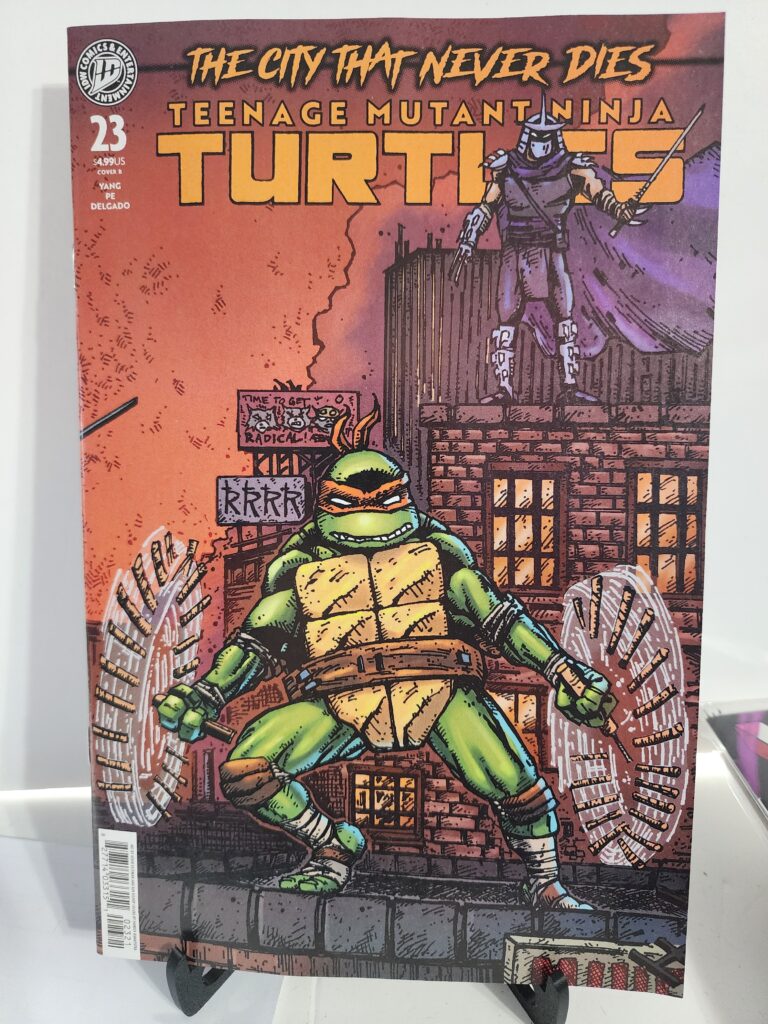
This copy features the Cover B Kevin Eastman and Ben Bishop Variant. The artwork brings Michelangelo and Shredder together in a gritty composition that immediately recalls the rougher visual style associated with the early days of Teenage Mutant Ninja Turtles.

Comic Book Details

  • Title: Teenage Mutant Ninja Turtles
  • Issue: #23
  • Volume: 6
  • Publisher: IDW Publishing
  • Release Date: October 14, 2026
  • Cover Date: October 2026
  • Written By: Gene Luen Yang
  • Art: Fero Pe
  • Cover Variant: Cover B Kevin Eastman & Ben Bishop Variant
  • Cover Artists: Kevin Eastman and Ben Bishop
  • Cover Price: $4.99
  • Pages: 32
  • Rating: T
  • UPC: 82771403315102321

IDW officially credits Kevin Eastman and Ben Bishop for this exact Cover B. Penguin Random House Comics Retail

Michelangelo dominates the foreground while Shredder watches from above. The rough lines, heavy shadows, brick buildings, and orange-red sky give the image an old-school independent-comic feel.

The cover looks modern without losing the raw visual energy that helped define Teenage Mutant Ninja Turtles in the first place.

Teenage Mutant Ninja Turtles #23 Comic Review: Story Analysis

Teenage Mutant Ninja Turtles #23 throws New York into supernatural chaos.

The barrier between worlds has broken down.

Undead members of the Foot Clan, Purple Dragons, and other threats begin flooding the city.

The Turtles cannot stay together and fight one battle at a time.

They have to split up.

That immediately raises the danger.

The brothers are usually strongest when they work as a unit. Separating them forces each Turtle to handle part of the crisis without relying on the entire family.

Writer Gene Luen Yang also keeps several other conflicts moving.

Baxter Stockman forms a dangerous new alliance.

Shinigami must decide where her loyalty truly belongs.

Those problems make the undead invasion more than a simple monster attack. Penguin Random House Comics Retail

The city faces threats from several directions at once.

That gives issue #23 a strong sense of momentum.

Art and Visual Design

Fero Pe handles the interior artwork.

An undead invasion gives the issue plenty of opportunities for visual chaos.

The familiar streets of New York become battlefields.

Foot Clan members and Purple Dragons already belong in the TMNT world. Turning those enemies into supernatural threats pushes the series further into horror without abandoning its action roots.

Fero Pe also has to make the divided storylines easy to follow.

The Turtles are not all fighting side by side.

Each part of the city needs its own sense of danger while still feeling connected to the larger crisis.

For this edition, however, the immediate attraction is Kevin Eastman and Ben Bishop’s Cover B.

The cover does not look overly polished.

That is one of its strengths.

The rougher approach gives Michelangelo a sense of movement and danger that fits the story.

Michelangelo and Shredder

Michelangelo is often the most lighthearted member of the team.

This cover does not present him that way.

He looks alert, battered, and ready to fight.

His nunchaku are already moving.

Shredder stands above him like a threat that never completely disappears.

That contrast works well.

Michelangelo brings energy to the lower half of the composition.

Shredder brings tension to the upper half.

Even without reading the issue, the image tells the reader that the situation has become serious.

An Old-School TMNT Feel

Kevin Eastman’s involvement gives the cover an immediate connection to the roots of Teenage Mutant Ninja Turtles.

Eastman helped create the franchise.

His name still carries special weight with TMNT collectors.

Ben Bishop complements that connection instead of trying to make the image look completely different.

The result feels like a modern interpretation of classic TMNT artwork.

Heavy lines and rough textures replace the cleaner finish seen on many current superhero covers.

The city feels dirty.

The characters look like they belong there.

That makes this version especially appealing to readers who prefer the visual personality of older TMNT comics.

Collectibility and Market Significance

Teenage Mutant Ninja Turtles #23 was released with several covers.

Fero Pe created Cover A. Kevin Eastman and Ben Bishop created Cover B. Marcelo Ventura, J. Gonzo, and Damien Worm also contributed variants. IDW released additional ratio incentive editions as well. Penguin Random House Comics Retail

The regular Eastman and Bishop Cover B is an open-order variant.

It is not the 1:10 black-and-white full-art incentive version.

That means collectors should not assume this edition is scarce.

Its appeal comes from the artists.

Kevin Eastman remains one of the most important names associated with TMNT.

Ben Bishop has also built a strong connection with modern Turtles artwork.

For longtime collectors, that combination gives Cover B more meaning than a random alternate image.

Final Verdict

Teenage Mutant Ninja Turtles #23 pushes New York deeper into supernatural chaos.

Gene Luen Yang gives the Turtles a threat large enough to force them apart. Fero Pe handles a city filled with undead enemies and multiple battles.

The issue also keeps Baxter Stockman and Shinigami involved in the larger conflict.

For collectors, the Kevin Eastman and Ben Bishop Cover B is the major attraction of this edition.

The rough artwork, Michelangelo-and-Shredder composition, and connection to TMNT history make it stand apart from the cleaner modern variants.

Recommended for TMNT readers, Michelangelo fans, Shredder collectors, Kevin Eastman collectors, Ben Bishop collectors, and readers following the current undead storyline.


Teenage Mutant Ninja Turtles #23 Kevin Eastman & Ben Bishop Cover B is available from Razmataz Comics & Hobbies at razmatazcomics.com while supplies last.
You’ll Never Leave This Place Alive #1 Comic Review – Alex Eckman-Lawn Cover Set Variant (2026)

A perfect community starts to collapse in You’ll Never Leave This Place Alive #1, featuring the Alex Eckman-Lawn Cover B cover set.

This You’ll Never Leave This Place Alive #1 comic review looks at IDW Dark’s new horror mystery from writers Collin Kelly and Jackson Lanzing.

Heather Vaughan handles the interior artwork. Alex Eckman-Lawn created the unusual Cover B cover-set presentation.

Phoebe “Phee” Joplin has spent her entire life inside a secluded community built by her parents and their friends.

She has always believed that world was safe.

Then graduation night changes everything.

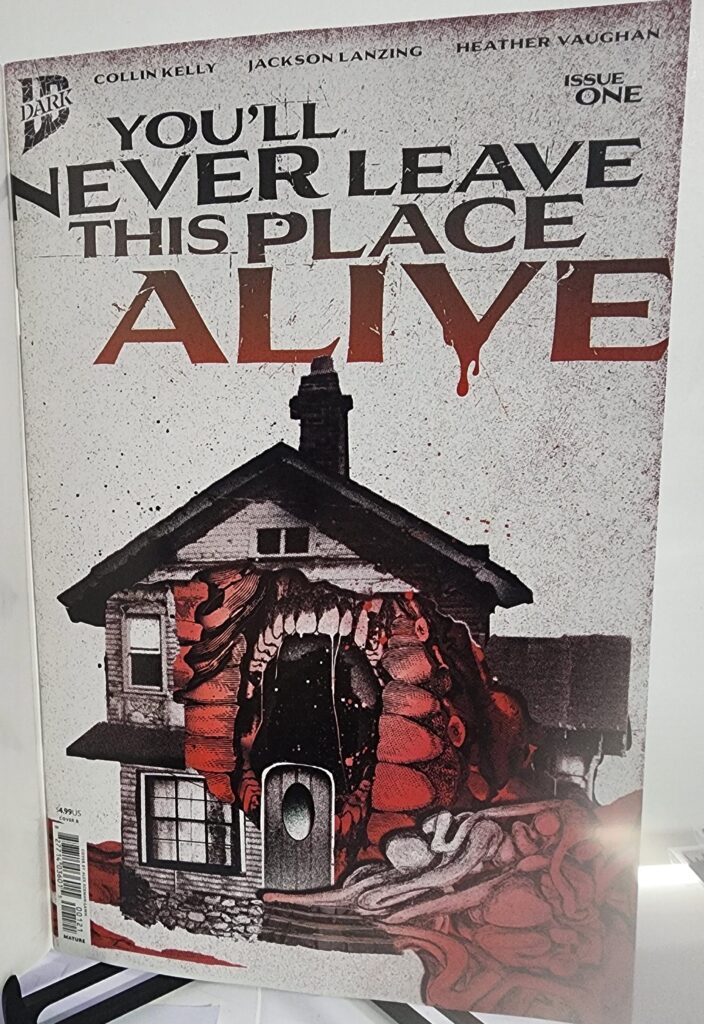
This copy features the Cover B Alex Eckman-Lawn Cover Set Variant. Unlike a normal illustrated cover, this edition uses a special cover-set presentation with the white outer element and the illustrated cover beneath it.

Comic Book Details

  • Title: You’ll Never Leave This Place Alive
  • Issue: #1
  • Volume: 1
  • Publisher: IDW Dark / IDW Publishing
  • Release Date: October 14, 2026
  • Cover Date: October 2026
  • Written By: Collin Kelly and Jackson Lanzing
  • Art: Heather Vaughan
  • Cover Variant: Cover B Alex Eckman-Lawn Cover Set
  • Cover Artist: Alex Eckman-Lawn
  • Cover Price: $4.99
  • Pages: 48
  • Rating: Mature
  • UPC: 82771403601500121

IDW officially identifies this edition as the Variant B Eckman-Lawn Cover Set. Penguin Random House Comics Retail

The unusual construction immediately separates this edition from the standard Cover A and the other illustrated variants.

Instead of relying on a conventional single front image, the cover-set presentation gives the issue an almost unfinished or hidden quality. That fits a story built around appearances, secrecy, and discovering what exists underneath a carefully constructed surface.

You’ll Never Leave This Place Alive #1 Comic Review: Story Analysis

You’ll Never Leave This Place Alive #1 begins with a simple idea.

Phee believes she grew up in the perfect place.

Her parents and their friends built a secluded community away from the problems of the outside world.

Five children grew up there together.

They received education, safety, structure, and protection from everything their parents considered dangerous.

Then one of them dies.

The death happens under circumstances that should not be possible.

That event changes everything for Phee.

The community stops feeling completely safe. Rules begin to look different. Adults she trusted suddenly raise questions.

Writers Collin Kelly and Jackson Lanzing build the horror around that growing doubt.

They do not reveal every secret immediately.

Instead, Phee begins pulling at the edges of the life she has always accepted.

The more she questions, the less secure the community becomes.

That approach works because the characters did not wander into a strange place.

They were raised there.

For Phee, discovering the truth means questioning her parents, her childhood, and nearly everything she understands about her own life.

Art and Visual Design

Heather Vaughan handles the interior artwork.

The story needs the community to feel believable before it can become frightening.

That makes the early visual presentation important.

Homes, rooms, and familiar spaces need to look normal enough that Phee would never question them.

As her doubts grow, those same environments begin to feel more restrictive.

That change gives the artwork an important role in the horror.

The story does not need constant monsters or gore.

A hallway, a house, or a familiar face can become disturbing once Phee stops trusting what she sees.

The Alex Eckman-Lawn Cover Set adds another unusual visual element to this edition.

The white outer portion creates a very different first impression from a standard printed comic cover.

It feels almost intentionally incomplete.

That presentation works well with a story about hidden layers and the danger of looking beneath the surface.

Phoebe Joplin

Phoebe Joplin begins the story with a major disadvantage.

She has no normal outside childhood to compare with her own.

The community is not somewhere she moved.

It is home.

The adults who built it are not strangers.

They are her family and the parents of her closest friends.

That makes every new suspicion harder to accept.

If Phee discovers that the community exists for reasons she never understood, then she must also accept that the people she trusted may have lied to her for years.

Her friendships matter just as much.

The five children grew up together inside a world almost nobody outside could understand.

One death threatens that entire bond.

Horror and Mystery

The book mixes horror and mystery effectively.

The mystery asks what the community really is.

The horror comes from what Phee may discover.

At first, the danger appears to come from outside normal life.

Then the story reverses that idea.

The place designed to protect the children may actually be the source of the danger.

That gives the title extra weight.

You’ll Never Leave This Place Alive sounds less like a warning about the outside world and more like a warning about home itself.

The limited-series format should also help the mystery stay focused.

There is no need to stretch the central question across dozens of issues.

Collectibility and Market Significance

You’ll Never Leave This Place Alive #1 launches a new IDW Dark horror series.

The first issue includes several covers.

Heather Vaughan created Cover A. Alex Eckman-Lawn created the Cover B Cover Set. Morgan Beem created the IDW Goes Dark Cover C. IDW also released higher-ratio Joshua Hixson incentive editions. G-Mart Comics

The Alex Eckman-Lawn edition is not a ratio incentive.

Its attraction comes from the unusual cover-set format and the artist attached to it.

That makes it different from a normal alternate illustration.

Collectors who like unusual cover formats may find this version more interesting than a standard open-order variant.

The fact that it is also issue #1 of a new horror series adds another collecting angle.

Final Verdict

You’ll Never Leave This Place Alive #1 starts with a strong psychological-horror idea.

Phee has spent her entire life believing that isolation kept her safe.

The first issue begins destroying that belief.

Collin Kelly and Jackson Lanzing build the mystery gradually. Heather Vaughan gives the story an uneasy visual atmosphere.

The Alex Eckman-Lawn Cover Set Variant adds something unusual to the physical comic itself.

Its layered presentation fits a story about appearances, hidden truths, and discovering what lies underneath.

Recommended for horror readers, mystery fans, IDW Dark collectors, Alex Eckman-Lawn collectors, and readers who enjoy stories about supposedly perfect communities hiding dangerous secrets.


You’ll Never Leave This Place Alive #1 Alex Eckman-Lawn Cover Set Variant is available from Razmataz Comics & Hobbies at razmatazcomics.com while supplies last.
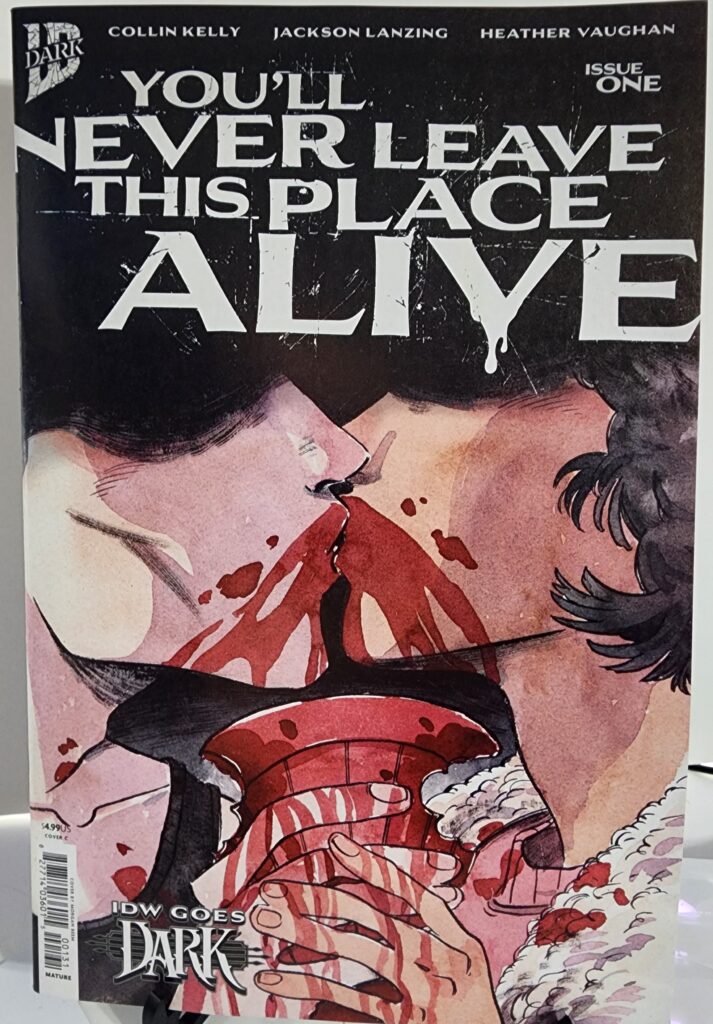
You’ll Never Leave This Place Alive #1 Comic Review – Morgan Beem IDW Goes Dark Variant (2026)

A perfect community becomes a nightmare in You’ll Never Leave This Place Alive #1. We review the horror debut and Morgan Beem variant.

This You’ll Never Leave This Place Alive #1 comic review looks at the debut of IDW Dark’s new horror mystery. Collin Kelly and Jackson Lanzing write the series, with artwork by Heather Vaughan.

Phoebe “Phee” Joplin has spent her entire life inside an isolated community. Her parents and their friends created it to escape the dangers of ordinary society.

Phee and four other children grew up believing their home was safe. That belief begins to collapse on the night of their graduation.

This copy features the Cover C Morgan Beem IDW Goes Dark Variant. Beem’s disturbing artwork fits a story built around hidden violence, mistrust, and a supposedly safe place hiding something much darker.

Comic Book Details

  • Title: You’ll Never Leave This Place Alive
  • Issue: #1
  • Volume: 1
  • Publisher: IDW Dark / IDW Publishing
  • Release Date: October 14, 2026
  • Cover Date: October 2026
  • Written By: Collin Kelly and Jackson Lanzing
  • Art: Heather Vaughan
  • Cover Variant: Cover C IDW Goes Dark Variant
  • Cover Artist: Morgan Beem
  • Cover Price: $4.99
  • Pages: 48
  • Rating: Mature
  • UPC: 82771403601500131

Morgan Beem’s cover immediately creates an uncomfortable mood. Blood, close framing, and soft colors make the image feel personal and threatening at the same time.

That contrast fits the story perfectly. Something familiar and intimate can still hide something dangerous underneath.

You’ll Never Leave This Place Alive #1 Comic Review: Story Analysis

The strongest part of You’ll Never Leave This Place Alive #1 is its central idea.

Phee grew up believing isolation meant protection.

Her parents removed their families from ordinary society and built a controlled community. They promised safety, education, stability, and freedom from outside dangers.

Then one of Phee’s friends dies.

The death should not have happened. It forces Phee to question everything around her.

Her home suddenly feels different. The adults seem less trustworthy. Rules that once felt protective begin to look more like restrictions.

Writers Collin Kelly and Jackson Lanzing let that doubt drive the story.

They do not explain every mystery immediately. Instead, they let Phee slowly realize that her entire life may rest on carefully constructed lies.

That makes the horror more effective.

Phee and her friends did not wander into a dangerous place.

They were born there.

For Phee, learning the truth may mean accepting that nearly everything she knows about her childhood was designed to control her.

Art and Visual Design

Heather Vaughan’s artwork gives the book much of its unsettling atmosphere.

The story needs the community to feel normal at first. Otherwise, Phee would never have accepted it as home.

Vaughan makes familiar spaces feel increasingly uncomfortable as Phee begins asking questions.

The horror does not depend on constant monsters or gore. Instead, expressions, rooms, relationships, and small details create tension.

That slower visual approach works well with the mystery.

As Phee becomes suspicious of her surroundings, the reader begins looking at those same surroundings differently.

For this edition, Morgan Beem’s IDW Goes Dark cover pushes the horror even further.

The image does not explain the plot. It creates a feeling.

Blood and intimacy dominate the composition. The soft watercolor-like appearance makes the violence feel even more disturbing.

It works as a strong introduction to the tone of the series.

Character Development

Phoebe Joplin faces a difficult problem because she has no normal outside life to compare against her own.

The community is not somewhere she moved.

It is the only home she knows.

The adults who built it are also the people who raised her.

That makes Phee’s growing distrust much more complicated.

If the community hides a terrible secret, then Phee must question her parents, her childhood, and the people she trusted most.

Her friendships also matter.

Phee and the other children share an upbringing that outsiders could never fully understand. The death at the center of the first issue threatens that bond.

As the mystery grows, they may also begin questioning one another.

Horror and Mystery

The horror and mystery work together well.

The mystery asks a simple question:

Why does this community really exist?

The horror comes from the possibility that Phee may not like the answer.

The title itself adds to that fear.

You’ll Never Leave This Place Alive suggests that escape may carry a terrible cost.

The series also has a limited three-issue format. That should help the story stay focused instead of stretching the mystery too far.

A short run gives the creative team room to build tension while still moving toward answers quickly.

Collectibility and Market Significance

You’ll Never Leave This Place Alive #1 launches a new IDW Dark horror miniseries.

The first issue also features several alternate covers.

This copy uses the Morgan Beem Cover C IDW Goes Dark Variant.

It is an open-order variant rather than a ratio incentive. Collectors should not assume it is rare simply because it is a variant.

The main attraction is the artwork.

Morgan Beem’s cover fits the horror theme extremely well. It also gives collectors a visually different option from the standard cover.

The first issue format adds another collecting angle. Readers who enjoy horror comics often like trying new series from the beginning.

For collectors of IDW Dark, Morgan Beem, or modern horror comics, this version has a strong visual identity.

Final Verdict

You’ll Never Leave This Place Alive #1 starts with a strong horror premise.

Phee has always believed the outside world was dangerous. Her parents taught her that the community kept everyone safe.

The first issue begins tearing that belief apart.

Collin Kelly and Jackson Lanzing build the mystery without revealing everything too quickly. Heather Vaughan gives the story an uneasy visual style that supports the growing distrust.

Morgan Beem’s IDW Goes Dark Variant fits the material especially well.

The cover feels disturbing before the reader even opens the book. That makes it feel like part of the horror experience rather than simply another alternate cover.

Recommended for horror readers, mystery fans, IDW Dark collectors, Morgan Beem collectors, and readers who enjoy stories where a safe place slowly becomes terrifying.


You’ll Never Leave This Place Alive #1 Morgan Beem IDW Goes Dark Variant is available from Razmataz Comics & Hobbies at razmatazcomics.com while supplies last.

Magic: The Gathering Untold Stories Liliana #1 Comic Review – Abigail Larson Variant (2026)

Liliana Vess hunts Griselbrand on Innistrad in Magic: The Gathering Untold Stories Liliana #1, featuring an Abigail Larson variant cover.

This Magic: The Gathering Untold Stories Liliana #1 comic review looks at Dark Horse’s new four-part story about Liliana Vess.

Torunn Grønbekk writes the series. Nataliia Rerekina handles the interior artwork, with colors by Lauren Affe.

Liliana gained incredible power through bargains with four demons. Those bargains also cost her pieces of her freedom.

Now she wants them back.

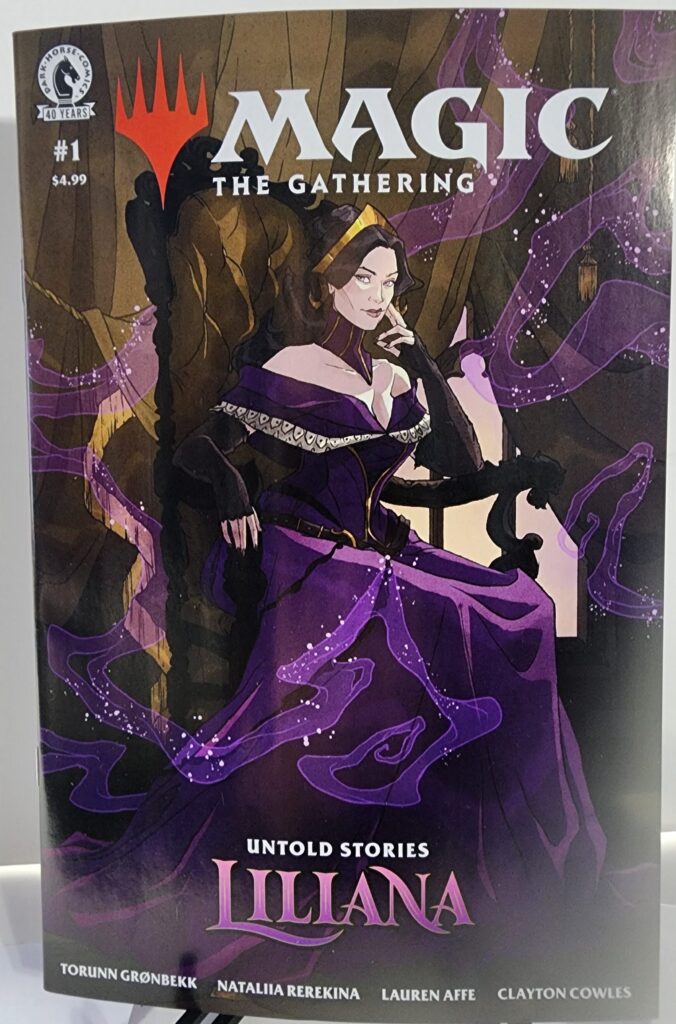
This copy features the Cover C Abigail Larson Variant. Larson presents Liliana surrounded by deep purple tones and flowing magical energy. The artwork immediately captures the dark fantasy style associated with the character.

Comic Book Details

  • Title: Magic: The Gathering: Untold Stories – Liliana
  • Issue: #1
  • Volume: 1
  • Publisher: Dark Horse Comics
  • Release Date: October 14, 2026
  • Cover Date: October 2026
  • Written By: Torunn Grønbekk
  • Art: Nataliia Rerekina
  • Colors: Lauren Affe
  • Letters: Clayton Cowles
  • Cover Variant: Cover C Abigail Larson Variant
  • Cover Artist: Abigail Larson
  • Cover Price: $4.99
  • Pages: 32
  • Rating: T
  • UPC: 76156801633800131
  • Series Length: 4 issues

Dark Horse confirms the creative team, $4.99 price, 32-page length, and four-issue format. PRH Comics

Abigail Larson’s cover leans directly into Liliana’s dark fantasy identity. Purple dominates the image, while spectral energy moves around her throne.

Liliana looks completely in control, but the darker background hints at the dangerous bargains that continue to shape her life.

Magic: The Gathering Untold Stories Liliana #1 Comic Review: Story Analysis

Liliana Vess possesses enormous power.

That power came with a price.

She bargained her soul to four powerful demons: Kothophed, Razaketh, Belzenlok, and Griselbrand.

Liliana eventually decided that freedom mattered more than the power those bargains gave her. She began hunting the demons tied to her contracts.

This story follows that struggle.

Her search brings her to Innistrad, where she believes she can find Griselbrand. The plane already suffers from corruption, chaos, and violence.

Liliana therefore walks into danger before she even reaches her true target.

The story also gives Dark Horse a chance to explore part of Liliana’s history rather than simply retell events Magic players already know. The publisher specifically presents this as an untold story from her past. PRH Comics

That makes the book accessible in two ways.

Longtime Magic players get another piece of Liliana’s history.

Newer readers get a straightforward dark fantasy story about a necromancer trying to escape the consequences of her own choices.

Art and Visual Design

Nataliia Rerekina handles the interior artwork.

Liliana’s story needs a strong sense of atmosphere. Innistrad is not a bright heroic fantasy setting.

It is a place filled with corruption, monsters, death, and supernatural danger.

That environment suits Liliana.

She works with death rather than running from it. Her magic can make horrific places feel almost natural to her.

The artwork therefore has to balance two ideas. Innistrad must feel threatening, but Liliana must still appear capable of surviving there.

For this edition, Abigail Larson’s cover pushes the gothic atmosphere even further.

Liliana sits almost like dark royalty. Purple magical shapes move throughout the composition.

The image is elegant rather than chaotic.

That suits Liliana because her danger often comes from confidence and control rather than brute force.

Liliana Vess

Liliana remains one of Magic: The Gathering’s most recognizable Planeswalkers.

Her power has always come with consequences.

The demonic bargains at the center of this story are a perfect example.

Liliana wanted greater power. She got it.

She also discovered that power does not mean much when someone else owns part of your future.

That gives the story a strong personal motivation.

Liliana does not hunt Griselbrand because someone ordered her to do it. She wants control over her own life.

That motivation makes her easy to understand even for readers who do not know every part of Magic lore.

She made terrible deals.

Now she intends to break them.

Innistrad and the Horror Setting

Innistrad is an excellent setting for this story.

The plane already mixes fantasy with gothic horror.

Vampires, demons, undead creatures, and other supernatural threats are normal parts of its world.

Liliana fits comfortably inside that environment.

Her necromancy does not feel out of place there. In many situations, she may be one of the least frightening things around.

That gives the series room to embrace horror without changing who Liliana is.

It also creates a good contrast.

Liliana arrives looking for one specific demon, but Innistrad contains plenty of other threats that can interfere with her plans.

Collectibility and Market Significance

Magic: The Gathering: Untold Stories – Liliana #1 begins a new four-issue Dark Horse miniseries.

Dark Horse released three regular covers for the first issue.

Nataliia Rerekina created Cover A. Sibylline Meynet created Cover B. Abigail Larson created Cover C. comicsbodega.com

All three carry the same original $4.99 cover price.

That means the Abigail Larson edition is an open-order variant rather than a ratio incentive.

Collectors should not assume scarcity based only on the variant designation.

The appeal comes from several other factors.

It is issue #1. It stars Liliana Vess. It begins a short four-part story. It also features artwork from a named cover artist with a style that fits the character particularly well.

Magic: The Gathering also brings a collector audience beyond traditional comic readers.

That makes the series interesting for both comic collectors and Magic fans who normally focus on cards or game-related merchandise.

Final Verdict

Magic: The Gathering: Untold Stories – Liliana #1 starts with a strong character and a simple goal.

Liliana wants her freedom.

Getting it means confronting the demons who hold pieces of her soul.

Torunn Grønbekk uses that premise to explore Liliana’s past while sending her into the gothic horror world of Innistrad.

Nataliia Rerekina supplies the interior artwork, while Abigail Larson gives this edition a strong dark-fantasy cover.

The Abigail Larson Cover C Variant is especially attractive for collectors who already associate Liliana with purple magic, necromancy, and gothic imagery.

Recommended for Magic: The Gathering fans, Liliana Vess collectors, Abigail Larson collectors, dark fantasy readers, and anyone interested in exploring Magic lore through comics.


Magic: The Gathering: Untold Stories – Liliana #1 Abigail Larson Variant is available from Razmataz Comics & Hobbies at razmatazcomics.com while supplies last.