
Infernal Hulk vs. Fantastic Four #1 begins with New York under threat and Reed Richards holding what may be one of the few weapons capable of stopping the coming disaster.
That weapon is the Immaculate Engine, a mysterious supernatural machine housed inside the Baxter Building.
Infernal Hulk knows exactly what it represents.
If Reed can activate the engine, Hulk’s growing army could potentially be destroyed in a single strike. That makes the Fantastic Four and their headquarters an obvious target.
Writer Phillip Kennedy Johnson uses the setup to bring two very different corners of Marvel together. The Fantastic Four traditionally approach impossible problems through science, exploration and teamwork. Infernal Hulk represents something far more primal and supernatural.
That collision creates the central tension of the issue.
The Fantastic Four are not simply trying to overpower Hulk. They have to resist his corruptive influence long enough to protect Reed’s invention and prevent themselves from being transformed into new recruits for the Infernal Avengers.
As a Hulk War Prelude, the one-shot also functions as a bridge into the larger conflict rather than an isolated battle.
Art and Visual Design
Cian Tormey handles the interior artwork, and the premise gives him a wide range of visual material to work with.
The Fantastic Four bring bright superhero imagery, technology and the familiar environments of the Baxter Building. Infernal Hulk brings monstrous proportions, supernatural corruption and horror.
That contrast is important because the story depends on Hulk feeling fundamentally different from the kind of threats Reed Richards usually solves with another invention.
The result is a battle between clean Marvel science-fiction imagery and something darker and less predictable.
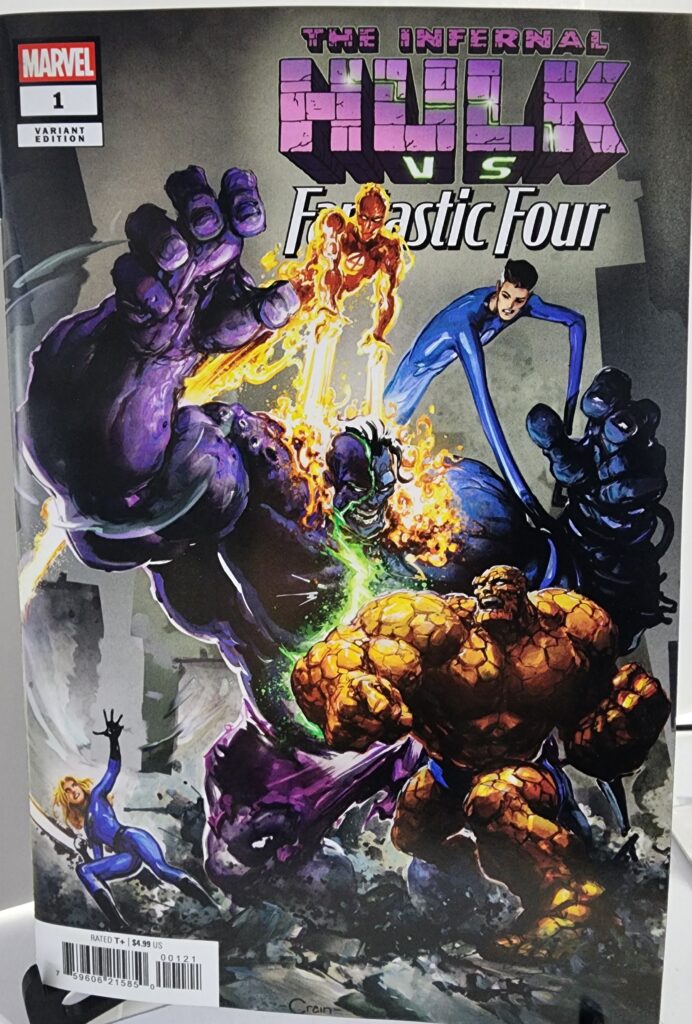
For this edition, Clayton Crain’s variant cover pushes heavily into that horror side.
Crain’s Infernal Hulk feels enormous, distorted and almost demonic, while the Fantastic Four appear comparatively small beneath him. The composition reinforces the scale of the threat before the reader ever opens the book.
Character Development
Reed Richards sits at the center of the conflict because the Immaculate Engine represents exactly the sort of solution readers expect from Mister Fantastic.
When an impossible threat appears, Reed builds something capable of confronting it.
The problem this time is that building the solution also makes the Fantastic Four a target.
Infernal Hulk understands that destroying the machine may not be enough. Corrupting the people responsible for it could turn some of Marvel’s greatest heroes into weapons against everyone else.
That gives the battle a more personal dimension than a simple Hulk-versus-Thing rematch.
The Fantastic Four have always been strongest as a family. A supernatural threat capable of twisting members of that family against one another attacks the team at its most important foundation.
Collectibility and Market Significance
Infernal Hulk vs. Fantastic Four #1 has several features that make it interesting for collectors.
It is a one-shot, serves as a Hulk War Prelude, and puts the Fantastic Four directly into the growing Infernal Hulk storyline.
Marvel released the issue with several covers, including regular open-order variants from Clayton Crain, Danny Earls and Ken Lashley, along with higher-ratio incentive covers by Greg Land and Ken Lashley. Penguin Random House Comics Retail
The Clayton Crain Variant is an open-order cover rather than a ratio incentive, so scarcity should not automatically be assumed.
Its appeal comes instead from Crain’s artwork and the subject matter.
Crain’s painted approach is especially well suited to Hulk, symbiotes and darker supernatural characters, making his version visually distinct from the other standard covers for the issue.
The combination of Fantastic Four, Infernal Hulk, a crossover one-shot and a named modern cover artist gives the book several different collector audiences.
Final Verdict
Infernal Hulk vs. Fantastic Four #1 takes the Fantastic Four out of their usual science-fiction comfort zone and throws them directly into the supernatural horror surrounding Infernal Hulk.
Phillip Kennedy Johnson’s premise gives Reed Richards something potentially capable of ending Hulk’s army while simultaneously making the entire Fantastic Four a target.
Cian Tormey handles the interior conflict, while Clayton Crain’s variant cover emphasizes the monstrous scale of Infernal Hulk and the danger facing Marvel’s First Family.
For collectors, the Clayton Crain Variant is one of the stronger visually themed versions of the issue, particularly for readers who prefer the darker side of modern Hulk stories.
Recommended for Hulk readers, Fantastic Four fans, Clayton Crain collectors, and anyone following the buildup to Hulk War.
Infernal Hulk vs. Fantastic Four #1 Clayton Crain Variant is available from Razmataz Comics & Hobbies at razmatazcomics.com while supplies last.